
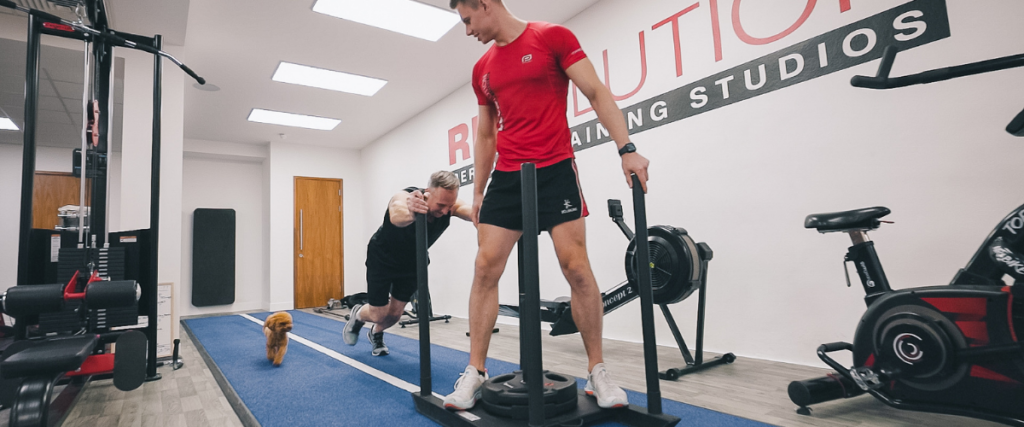
The most reliable gym motivation comes from systems, not feelings. It takes 66 days on average to build a consistent gym habit, according to UCL research — not the 21 days you’ve probably heard. Motivation follows action, not the other way around. Training with a personal trainer or workout partner increases gym attendance by up to 200% compared to training alone.
Everyone starts a gym routine with motivation. The problem is still going six months in, on a Tuesday evening when you’re tired, the novelty is long gone, and progress feels slow. Gym motivation isn’t a personality trait — it’s a system problem. And system problems have system solutions. Here’s what actually works, from our experience working with London professionals at Revolution PTS.
Key Takeaways
- Motivation is unreliable — habit formation and environmental design drive long-term gym consistency
- It takes 66 days on average (not 21) to establish a consistent exercise habit, per UCL research
- Training with a partner or coach increases gym attendance rates by up to 200% versus training alone
- Tracking measurable progress — strength gains, measurements, photos — sustains gym motivation better than scale weight alone
What Is the Best Gym Motivation Strategy That Actually Works?
The best gym motivation strategy is to stop relying on motivation entirely. That sounds counterintuitive, but it’s the most honest answer. Motivation is an emotional state — it arrives uninvited and leaves the same way. Building a gym habit on motivation is like building a business on enthusiasm. It gets you started. It doesn’t keep you going.
What actually works is a combination of three things: habit stacking, environment design, and identity shift.
Habit stacking means attaching your gym session to an existing, non-negotiable part of your day. “Gym immediately after work, before going home” is one of the most effective versions. Once you’re home, the decision is lost — the sofa wins every time. By making the gym the automatic next step after work, you remove the decision window entirely.
Environment design means reducing friction to near zero. Pack your gym bag the night before. Choose a gym on your commute route rather than a detour. Have your training playlist ready. Remove the logistical barriers that give your brain an excuse to opt out. Research on behaviour change consistently shows that reducing friction — even by two minutes — meaningfully increases follow-through.
Identity shift means reframing from “I’m trying to go to the gym more” to “I’m someone who trains.” Research consistently shows that identity-based habits sustain behaviour far longer than goal-based habits. Goals have an end point. Identity doesn’t. When you miss a session, a goal-based thinker feels like a failure. An identity-based thinker sees it as an anomaly and gets back on track without drama.
In our experience at Revolution PTS, the clients who build genuinely lasting gym habits aren’t the most disciplined — they’re the ones who stopped fighting their own inconsistency and built structures that make consistency the path of least resistance.
What Is the 5-3-1 Rule in Gym?
The 5-3-1 rule refers to Jim Wendler’s 5/3/1 strength training programme — one of the most widely used frameworks for building consistent, long-term strength. It’s built around four compound lifts: squat, bench press, deadlift, and overhead press, each trained once per week.
Each training cycle lasts four weeks and rotates through three loading phases. Week one: 3 sets of 5 reps at progressively heavier percentages of your one-rep max. Week two: 3 sets of 3 reps, heavier again. Week three: one set of 5, one set of 3, one set of 1-plus (as many reps as possible at a near-maximal weight). Week four is a planned deload at lighter weights.
The reason 5/3/1 is particularly effective for gym motivation is built into the design: every four-week cycle, you add a small amount of weight to each lift — typically 2.5kg on upper body lifts and 5kg on lower body. That means every cycle guarantees a new personal best on at least one exercise. Measurable, visible progress is the most reliable driver of intrinsic motivation in strength training. When the numbers keep going up, you keep showing up.
For anyone whose gym motivation has stalled because progress feels invisible, 5/3/1 directly solves the problem. You have a specific weight to beat. That clarity removes the vagueness that quietly kills gym consistency over time.
What Is the 3-3-3 Rule Gym?
The 3-3-3 rule in the gym means training 3 days per week, doing 3 exercises per session, for 3 sets each. It’s a minimum effective dose framework designed for people who struggle with gym consistency — not because they’re lazy, but because complexity and time commitment are their real obstacles.
Nine total working sets, three days per week, takes roughly 25 to 35 minutes per session. That’s short enough to fit into almost any schedule and never feel like a major commitment. The psychological power of the 3-3-3 rule is that it removes the overwhelm of complicated programming. You don’t need to decide between 15 possible exercises or optimise rest periods. Three movements, three sets, done.
A well-structured 3-3-3 session covers one push (bench press, push-up, or overhead press), one pull (row, pull-up, or lat pulldown), and one compound leg movement (squat, deadlift, or lunge). Three sets of 8 to 12 reps on each. Research confirms that this volume — 9 to 18 working sets per week — is sufficient to maintain and gradually build muscle and strength for non-competitive trainees.
The 3-3-3 rule is also the most effective re-entry framework after a break. When you’ve been out of the gym for weeks or months, resuming a full programme feels daunting. Three exercises, three sets, three days is a concrete starting point that doesn’t require you to be at full capacity.
What Is the 3 2 1 Rule in Gym?
The 3-2-1 rule is a weekly training structure rather than a per-session protocol. It breaks down as: 3 strength training sessions, 2 cardio sessions, and 1 active recovery day per week. Six days of structured movement with one complete rest day.
The appeal of the 3-2-1 structure is that it gives equal structure to cardio and recovery — two components that drop off first when motivation dips. Cardio tends to disappear when people get busy, and active recovery (light walking, yoga, stretching) gets skipped because it doesn’t feel productive enough. The 3-2-1 framework treats all three as non-negotiable parts of a complete training week.
In practice: strength on Monday, Wednesday, Friday. Cardio on Tuesday and Thursday — a 30-minute run, a rowing session, or a cycling effort. Active recovery on Saturday: a long walk, a mobility session, or a yoga class. Sunday completely off.
From a motivation standpoint, the 3-2-1 rule works because variety reduces boredom. One of the most common reasons people lose gym motivation around weeks 8 to 12 is that training starts feeling monotonous. Alternating between strength and cardio sessions gives each day a different purpose and a different feeling — which keeps the routine from becoming something you dread.
Why Do People Lose Gym Motivation After the First Month?
The one-month motivation drop is one of the most well-documented patterns in exercise behaviour research, and it has a straightforward cause: the novelty effect wears off. When you start a new gym routine, your brain generates real dopamine from the newness — the environment, the anticipation of results, the feeling of doing something positive. That neurological reward fades within four to six weeks once the novelty is gone.
At the same time, most people hit what behaviour change researchers call the “valley of despair.” You’ve been training for four weeks. You expected to look different by now. You don’t — or not as dramatically as you imagined. The gap between expectation and reality triggers a reassessment: is this worth it? For people without external accountability, the answer at this point is often no.
The reality is that body composition changes take three to four months to become clearly visible. Strength gains follow a predictable curve: fast in the early weeks, then slower as you advance. If you’re judging progress at week four against a timeline that requires week sixteen to play out, you’ll always feel behind.
In our experience at Revolution PTS, clients who navigate this valley successfully are the ones with multiple metrics to track. A strength number that’s improving, a waist measurement that’s decreasing, a resting heart rate that’s dropping. When body weight stalls — as it reliably does during certain weeks — another metric is always moving in the right direction.
The structural fix is to introduce accountability at weeks four and five — the highest-risk dropout window. A training partner who expects you, a personal trainer you’ve booked, a fitness challenge with a defined end date. External accountability bridges the gap between novelty fading and habit forming.
Does a Personal Trainer Help with Gym Motivation?
Yes — and the research is consistent on this. People who train with a personal trainer are two to three times more likely to maintain exercise consistency over 12 months than those who train alone. Three mechanisms explain why: accountability, structure, and the investment effect.
Accountability works because human beings are far more likely to honour commitments to other people than commitments to themselves. When a trainer expects you at 7am on Wednesday, the social and financial cost of not showing up is real. That friction alone reduces cancellations dramatically compared to self-directed sessions where the only person you’re letting down is yourself.
Structure eliminates the second biggest consistency killer: decision fatigue. Not knowing what to do when you walk in, or feeling uncertain whether your programme is still working, are the two most common reasons people quit the gym between weeks six and ten. A trainer removes both simultaneously. You arrive, you do the programme, you leave.
The investment effect is real: when you’ve paid for a session, loss aversion works in your favour. Cancelling costs you money you’ve already spent. That friction alone meaningfully increases attendance rates.
In our experience at Revolution PTS, even clients who come to us saying they just need accountability discover that structured programming and measurable targets change their relationship with the gym entirely. The accountability gets them through the door. The results — which come faster with professional programming — keep them coming back.
How to Get Gym Motivation Back After a Break
The most common mistake when restarting after a break is trying to pick up where you left off. After two to four weeks of inactivity, your body has partially de-adapted. Attempting your previous weights or volume on day one leads to excessive soreness, potential injury, and the demoralising experience of feeling weaker than you remember. None of that helps motivation.
Start at 60 to 70% of your previous weights and treat the first two weeks as a deliberate re-entry phase. The goal in weeks one and two is not performance — it’s re-establishing the movement patterns and scheduling habits that make training feel automatic again. Muscle memory is real: strength returns significantly faster than it was originally built, usually within three to six weeks.
Reduce the commitment threshold. If a five-day programme feels overwhelming after time off, use the 3-3-3 rule: three exercises, three sets, three days per week. Give yourself permission to do less than your pre-break routine for the first month. Consistency at lower intensity beats inconsistency at high intensity without exception.
Focus the first two weeks on re-anchoring the habit rather than chasing results. Same time, same days, same pre-gym routine. The goal is rebuilding the automatic behaviour — not immediately returning to peak performance. Once the habit is re-anchored, usually within three to four weeks, increase intensity and volume progressively.
Don’t treat the break as a failure that needs correcting. Breaks happen to everyone, including professional athletes. The UCL habit formation research found that missing occasional sessions doesn’t significantly disrupt the habit formation process. The only thing that matters is restarting — and the sooner and lower-barrier that restart is, the better.
Ready to Build a Training Habit That Actually Sticks?
Gym motivation is not a fixed trait you either have or you don’t. It’s a system you build. The frameworks here — identity-based habits, the 3-3-3 rule, the 5/3/1 programme, the 3-2-1 weekly structure, accountability partnerships — all work by replacing the unreliable emotional state of motivation with structures that make consistency the natural outcome.
At Revolution PTS, our personal training studios in Angel, City, and Holborn are built specifically for London professionals who need results without the motivation rollercoaster. Our trainers provide the accountability, the structured programme, and the measurable targets that turn gym attendance from a daily decision into a reliable habit.
Book your complimentary consultation and find out how we make long-term consistency achievable for your schedule and lifestyle.
Why do I suddenly have no motivation to go to the gym?
Sudden loss of gym motivation is almost always caused by one of three things: overtraining and accumulated fatigue (the body telling you to rest), lifestyle stress displacing bandwidth for discretionary activities, or a lack of visible progress leading to the feeling that effort is wasted. The solution depends on the cause: a planned deload week, stress management, or a change of goal or programme respectively.
How do professional athletes stay motivated to train?
Professional athletes don’t rely on motivation — they rely on process commitment, team accountability, and scheduled training that happens regardless of how they feel. Most elite athletes report that roughly 40% of their training sessions feel difficult to start. What distinguishes them is the structured environment, external accountability, and habit automaticity built over years — not superior motivation. The same principles apply to recreational training.
What is the 3-3-3 rule for working out?
The 3-3-3 workout rule means committing to training at least 3 times per week, for at least 3 months, before evaluating whether it’s working. Three sessions per week is the minimum frequency to see consistent physiological adaptations. Three months is roughly the time needed for body composition changes to become visibly noticeable. Quitting before this threshold means quitting before you would have seen results.
Is it okay to take a week off from the gym?
Yes — a planned week off (called a deload) every 6–12 weeks is beneficial rather than harmful. Research shows muscle memory means strength returns quickly after brief rest periods, and the recovery from accumulated fatigue often produces improved performance on return. The risk of taking a week off is almost always psychological — the fear of losing progress — rather than physiological.
Does working out with a personal trainer actually help motivation?
Consistently, yes. The accountability of a scheduled appointment with a trainer — that you’ve paid for — dramatically reduces the likelihood of skipping sessions. Research shows people cancel trainer appointments at less than a third the rate of self-directed gym sessions. Beyond the appointment commitment, trainers provide real-time feedback that makes sessions feel more productive, which sustains motivation through visible progress.
How long does it take to build a consistent gym habit?
Research from University College London found habit formation takes an average of 66 days — ranging from 18 to 254 days depending on the behaviour and individual. For gym attendance specifically, the first six weeks are the highest dropout risk. After 12 consecutive weeks of regular training, most people report that missing sessions starts to feel uncomfortable, which signals genuine habit formation.
Sources
- Lally, P. et al. (2010). How are habits formed: Modelling habit formation in the real world. European Journal of Social Psychology, 40(6), 998-1009. University College London.
- Williams, S.L. & French, D.P. (2011). What are the most effective intervention techniques for changing physical activity self-efficacy and physical activity behaviour? Health Education Research, 26(2), 308-322.
- NHS (2024). Exercise: benefits for mental health. nhs.uk