Quick Answer: Most women gain 5–10 pounds during the menopause transition, averaging 1–2 pounds per year. Declining oestrogen causes fat to shift to the abdomen even without dietary changes. Strength training 2–3 times weekly and increasing protein to 1.6–2g per kg bodyweight are the most effective countermeasures.
Key Takeaways
- Menopause weight gain typically ranges from 2-5 pounds, largely driven by hormonal shifts in oestrogen and progesterone that change how the body stores fat.
- Fat redistribution toward the midsection during menopause increases visceral fat, which carries greater health risks than subcutaneous fat elsewhere on the body.
- Strength training is especially important during menopause as it helps preserve muscle mass, maintain metabolic rate, and support bone density.
- A modest calorie deficit of 250-500 calories per day, combined with higher protein intake, is more sustainable and effective than extreme dieting.
- Sleep disruption and elevated cortisol during menopause can contribute to weight gain, making stress management and sleep hygiene essential parts of any plan.
Menopause weight gain averages 1-2 pounds per year, with fat shifting to the abdomen regardless of diet or exercise habits, due to declining oestrogen levels affecting metabolism and fat storage. Strength training is 40% more effective than cardio for managing menopausal weight, while protein intake needs to increase to 1.6-2g per kilogram bodyweight. The good news: targeted strategies can significantly slow or prevent this gain.
If you’re gaining weight despite eating and exercising the same way you always have, you’re not imagining it—and it’s not a lack of willpower. Hormonal changes during the menopause transition fundamentally alter how your body processes food and stores fat.
- It’s hormonal, not just calories: Declining oestrogen changes metabolism and fat distribution patterns throughout the menopause transition
- Strength training is essential: Resistance exercise is significantly more effective than cardio for menopause weight management
- Protein needs increase: Aim for 1.6-2g protein per kilogram bodyweight to preserve muscle
- Sleep and stress matter more: Both directly affect cortisol and weight gain during this phase
Why Does Weight Gain Happen During Menopause?
Declining oestrogen levels reduce metabolic rate, increase fat storage around the abdomen, and make it harder to maintain muscle mass—all contributing to weight gain even without dietary changes. These changes begin during perimenopause and continue through post-menopause.
Several mechanisms drive menopausal weight gain:
Metabolic slowdown: Oestrogen helps regulate metabolism. As levels decline, you burn fewer calories at rest. Research suggests a 2-4% metabolic decline during the menopause transition beyond normal aging.
Fat redistribution: Oestrogen previously directed fat storage to hips and thighs. Without it, fat shifts to the abdomen—visceral fat around organs rather than subcutaneous fat under skin.
Muscle loss acceleration: Oestrogen helps maintain muscle. Declining levels accelerate sarcopenia (age-related muscle loss), further reducing metabolism since muscle burns more calories than fat.
Insulin resistance: Hormonal changes can affect how your body processes carbohydrates, making blood sugar regulation harder.
How Much Weight Gain Is Normal During Menopause?
Most women gain 5-10 pounds during the menopausal transition (typically 4-8 years), averaging 1-2 pounds per year without intervention.
This varies significantly based on:
- Starting weight and body composition
- Exercise habits (especially strength training)
- Diet quality and protein intake
- Sleep quality
- Stress levels
- Genetic factors
Weight gain isn’t inevitable—women who adjust their approach to account for hormonal changes can maintain or even improve their body composition. But continuing exactly as before typically results in gradual gain.
Why Does Fat Move to the Stomach During Menopause?
Without oestrogen’s regulatory influence, cortisol (the stress hormone) has more impact on fat storage, and cortisol preferentially deposits fat around the abdomen.
This shift from “pear” to “apple” shape isn’t just aesthetic—abdominal fat is more metabolically active and associated with higher health risks than fat stored elsewhere.
The visceral fat that increases during menopause wraps around internal organs and produces inflammatory compounds. This is why waist circumference becomes an important health marker during midlife, sometimes more meaningful than scale weight.
The shift typically begins in early perimenopause (often mid-40s) and continues through menopause and beyond. Addressing it early is more effective than waiting until significant accumulation has occurred.
What’s the Best Exercise for Menopause Weight Gain?
Strength training 2-3 times weekly is the most effective exercise intervention, shown to be 40% more effective than cardio alone for managing menopausal body composition.
Why strength training wins:
- Preserves muscle: Counteracts the accelerated muscle loss of menopause
- Boosts metabolism: Muscle burns more calories at rest than fat
- Targets visceral fat: Research shows resistance training specifically reduces abdominal fat
- Improves insulin sensitivity: Helps with blood sugar regulation
“Postmenopausal women performing resistance training three times weekly preserved significantly more lean muscle mass and had greater reductions in visceral adipose tissue compared to aerobic exercise alone.” — American College of Sports Medicine, Position Stand on Exercise and Physical Activity for Older Adults, 2009
| Exercise Type | Visceral Fat Reduction | Muscle Preservation | Metabolic Impact |
|---|---|---|---|
| Strength training (2-3x/week) | High | High | Long-term increase |
| Cardio only | Moderate | Low | Minimal change |
| HIIT | Moderate-High | Moderate | Short-term boost |
| Walking (daily) | Low-Moderate | Low | Minimal |
Cardio has its place for heart health and mood, but it doesn’t address the muscle loss that’s driving metabolic decline. Many women increase cardio when weight creeps up, but this approach often backfires—excessive cardio can increase cortisol and doesn’t build the muscle needed to boost metabolism.
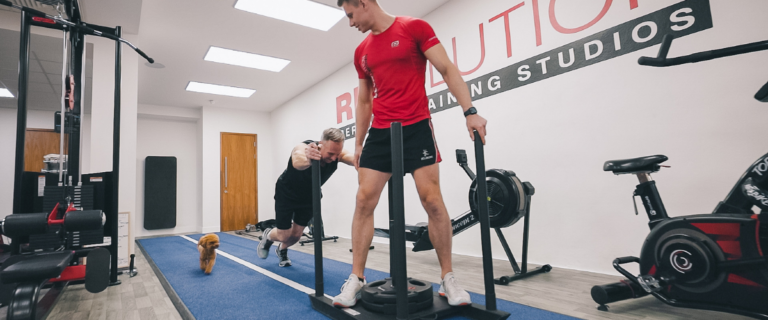
At Revolution Personal Training Studios, our programmes for women going through the menopause transition prioritise strength training with appropriate cardio, not the reverse.
How Should You Eat to Manage Menopause Weight Gain?
Increase protein to 1.6-2g per kilogram bodyweight, moderate carbohydrate intake (especially refined carbs), and maintain a modest calorie deficit of 200-400 calories if actively trying to lose weight.
Protein is paramount: Your body becomes less efficient at using protein to build and maintain muscle (called anabolic resistance). You need more protein to get the same effect. For a 70kg woman, this means 112-140g protein daily.
Carbohydrate awareness: Blood sugar regulation becomes harder during menopause. This doesn’t mean eliminating carbs, but choosing whole grains, vegetables, and legumes over refined options helps manage insulin levels.
Avoid extreme restriction: Severe calorie cutting increases cortisol, promotes muscle loss, and often backfires. A modest deficit with adequate protein is more effective than aggressive dieting.
Anti-inflammatory foods: Menopause increases inflammation. Fatty fish, olive oil, berries, leafy greens, and nuts can help counteract this.
What Foods Should You Avoid for Menopause Weight Gain?
No food is universally off limits, but some make managing weight during the menopause transition significantly harder:
Ultra-processed foods: Engineered to override satiety signals, easy to overeat, and cause blood sugar spikes that worsen the insulin resistance already developing during menopause.
Alcohol: Dense in calories, raises cortisol, disrupts sleep (already fragile during this phase), and directly impairs fat metabolism. Even modest intake compounds abdominal fat accumulation.
Refined carbohydrates: White bread, pastries, sugary drinks—these drive the blood sugar dysregulation that worsens with declining oestrogen. Swap for whole grains, legumes, and fibre-rich vegetables.
Focus on eating more of what works: protein at every meal, omega-3-rich fish twice weekly, colourful vegetables for fibre and antioxidants. The goal is crowding out the unhelpful foods rather than white-knuckling restriction.
Does Sleep Affect Menopause Weight Gain?
Poor sleep significantly accelerates menopausal weight gain by increasing cortisol, disrupting hunger hormones, and reducing insulin sensitivity.
Unfortunately, sleep often deteriorates during the menopause transition—night sweats, temperature regulation issues, and hormonal fluctuations all interfere. But the impact on weight is substantial:
- Sleep deprivation increases ghrelin (hunger hormone) and decreases leptin (fullness hormone)
- Cortisol rises with poor sleep, promoting abdominal fat storage
- Insulin sensitivity decreases, making carbohydrate processing less efficient
- Decision-making and willpower suffer, making healthy food choices harder
Addressing sleep is often as important as diet and exercise for menopause weight management. If symptoms are severe, discuss options with your GP.
Can HRT Help With Menopause Weight Gain?
Hormone replacement therapy can help prevent the metabolic changes and fat redistribution of menopause, though it’s not a weight loss treatment and isn’t suitable for everyone.
Research shows HRT can:
- Help maintain muscle mass
- Reduce visceral fat accumulation
- Improve insulin sensitivity
- Support better sleep (reducing cortisol)
However, HRT is a medical decision with benefits and risks that vary by individual. It’s not required for weight management—exercise and nutrition strategies are effective regardless of HRT status. Discuss with your GP if you’re considering it.
How Do You Kick-Start Your Metabolism After Menopause?
Post-menopause hormones stabilise, which actually makes consistent progress more achievable. Five evidence-based approaches:
Build muscle through strength training: This is the primary driver. Each pound of muscle burns roughly 6-10 extra calories at rest daily. Three sessions weekly compounds significantly over months.
Increase NEAT (non-exercise activity): Standing, walking, taking stairs—background movement throughout the day contributes meaningfully to total calorie burn. Aim for 7,000-8,000 steps daily as a baseline.
Prioritise protein at every meal: Protein has a 25-30% thermic effect—meaning your body burns more calories digesting it than carbs or fat. This small metabolic boost adds up across three meals daily.
Sleep 7-8 hours consistently: Poor sleep measurably reduces resting metabolic rate and increases fat storage hormones. Sleep is a metabolic lever, not a luxury.
Stay well hydrated: Even mild dehydration impairs metabolic processes. Aim for 1.5-2 litres daily, more on training days.
At what age does menopause weight gain start?
Perimenopause typically begins in the mid-40s (average age 47), though it can start in the early 40s or not until the early 50s. Weight changes often begin with early hormonal shifts, sometimes before other symptoms are noticeable. The transition through to post-menopause typically spans 4-8 years.
Why am I gaining weight even though I’m eating less?
Metabolic changes during menopause mean your body burns fewer calories than before. Eating the same or even less may not create the deficit it once did. Additionally, if you’re losing muscle (common during this phase), your resting metabolism decreases further. The solution is recalibrating your approach rather than simply eating less.
Can you lose weight during menopause?
Absolutely. It requires adjusting your approach—prioritising strength training, increasing protein, managing sleep and stress—but weight loss and body composition improvement are achievable throughout the menopause transition. The process may be slower than at younger ages, but with the right strategy it works consistently.
Should I weigh myself during menopause?
Scale weight becomes less reliable during the menopause transition due to fluid fluctuations. Waist measurements, how clothes fit, and progress photos are often more useful indicators. If you weigh yourself, focus on trends over weeks, not daily fluctuations.
How long does menopause weight gain last?
The active gain phase typically occurs during the perimenopausal transition (4-8 years). After menopause, hormones stabilise. Weight gain doesn’t continue indefinitely, but the fat redistribution (abdominal fat) can persist without targeted intervention. The good news: post-menopause is often when consistent exercise and nutrition strategies produce the most predictable results.
Is intermittent fasting good for menopause weight gain?
Results are mixed. Some women find intermittent fasting helpful; others experience increased cortisol and worsened symptoms. If you try it, monitor how you feel. Aggressive fasting protocols are generally not recommended during the menopause transition due to stress hormone effects.
How do you get rid of post-menopause weight gain?
Yes, it’s possible. Focus on strength training 2-3x weekly, protein at 1.6-2g/kg bodyweight, a modest calorie deficit of 200-400 calories, and managing cortisol through sleep and stress. Post-menopause hormones stabilise, which makes results more predictable than during the transition itself. Consistency over 8-12 weeks produces measurable changes in body composition.
How do you stop menopause weight gain from continuing?
The most effective approach combines strength training 2-3x weekly, protein at 1.6-2g/kg, sleep optimisation to control cortisol, and a modest rather than aggressive calorie deficit. Women who implement all four levers consistently see weight stabilise within 6-8 weeks.
Your Next Step
Menopause weight gain is driven by hormonal changes, not personal failure. Understanding the mechanisms helps you respond effectively: prioritise strength training, increase protein, address sleep, and adjust expectations for a body that’s operating differently than before.
If you’d like guidance tailored to where you are in your menopause journey, our trainers at Revolution Personal Training Studios specialise in helping women navigate these changes. We offer a free taster session to discuss your specific situation and goals.
Written by: Revolution Personal Training Studios
Last Updated: March 2026
Sources
- International Menopause Society (2022) — Weight and Body Composition Position Statement. Climacteric.
- Greendale et al. (2019) — Changes in Body Composition and Weight During the Menopause Transition. JCI Insight.
- NHS (2023) — Perimenopause and Menopause: Overview. National Health Service.
- British Menopause Society (2023) — Lifestyle and Weight Management Recommendations. Post Reproductive Health.
- ACSM (2009) — Exercise and Physical Activity for Older Adults. Medicine & Science in Sports & Exercise.